First Power Analysis in Python with MCPower
Every power analysis answers one of two questions:
- Given a sample size, how much power do I have? —
find_power - Given a power target, what sample size do I need? —
find_sample_size
You only need to learn these two calls once. Every later rung changes the model and reuses them unchanged.
The model
We reuse the study from the landing page: does a treatment lift satisfaction,
controlling for age?
- the formula
satisfaction = treatment + agenames the outcome and predictors; set_variable_typemarkstreatmentas binary (a 0/1 group), leavingagecontinuous;set_effectssets the standardised effect we want to detect — see effect sizes for the 0.10 / 0.25 / 0.40 benchmarks.
target_test="all" reports every predictor plus the overall F test; verbose=False
returns the result object instead of auto-printing, so we can call .summary().
How much power at n = 120?
from mcpower import MCPower

model = MCPower("satisfaction = treatment + age")
model.set_variable_type("treatment=binary")
model.set_effects("treatment=0.5, age=0.3")

result = model.find_power(sample_size=120, target_test="all", verbose=False)
print(result.summary())
==================================================
  MCPower · Power Analysis
==================================================
formula: satisfaction = treatment + age
estimator: OLS  N=120  sims=1600  α=0.05  target=80%
effects: treatment=0.50, age=0.30

Per-test power
───────────────────────────────────
Test                 Power   Target
───────────────────────────────────
Overall F            97.0%      80%
treatment            77.4%      80%
age                  88.4%      80%
───────────────────────────────────

Power & 95% CI
───────────────────────────────────────────
Test                 Power           CI 95%
───────────────────────────────────────────
Overall F            97.0%   [96.0%, 97.7%]
treatment            77.4%   [75.3%, 79.4%]
age                  88.4%   [86.8%, 89.9%]
───────────────────────────────────────────
95% CIs are Monte-Carlo (Wilson), n_sims=1600.

Joint significance distribution
────────────────────────
k     Exactly   At least
────────────────────────
0        3.1%       100%
1       28.1%      96.9%
2       68.9%      68.9%
────────────────────────

Plots: result.plot() to view, result.plot('chart.png') to save.
treatment lands at 77.4% — below the 80% target — while age is comfortably
powered at 88.4%. The joint significance distribution at the bottom gives the
chance of detecting both effects in the same study (68.9%), which is necessarily
lower than either alone.
What sample size reaches 80%?
find_sample_size simulates a grid of sample sizes (here 40 to 200 in steps
of 20), fits a power curve through the results, and reports the n where that
curve crosses the target:
from mcpower import MCPower

model = MCPower("satisfaction = treatment + age")
model.set_variable_type("treatment=binary")
model.set_effects("treatment=0.5, age=0.3")

result = model.find_sample_size(target_test="all", from_size=40, to_size=200, by=20, verbose=False)
print(result.summary())
==================================================
  MCPower · Power Analysis
==================================================
formula: satisfaction = treatment + age
estimator: OLS  N≥129  sims=1600  α=0.05  target=80%
effects: treatment=0.50, age=0.30

Required sample size per effect
───────────────────────────────
Test                 Required N
───────────────────────────────
Overall F                    70
treatment                   129
age                          96
───────────────────────────────

Required N & 95% CI
────────────────────────────────────────────
Test                 Required N       CI 95%
────────────────────────────────────────────
Overall F                    70     [66, 74]
treatment                   129   [122, 135]
age                          96    [91, 101]
────────────────────────────────────────────
Required N from the model-based crossing fit (isotonic); CI by Wilson band inversion, rounded outward.

Joint detection → required N (target 80%)
───────────────────────────────
Joint target         Required N
───────────────────────────────
≥ 2 of 2 tests              145
≥ 1 of 2 tests               65
───────────────────────────────

Plots: result.plot() to view, result.plot('chart.png') to save.
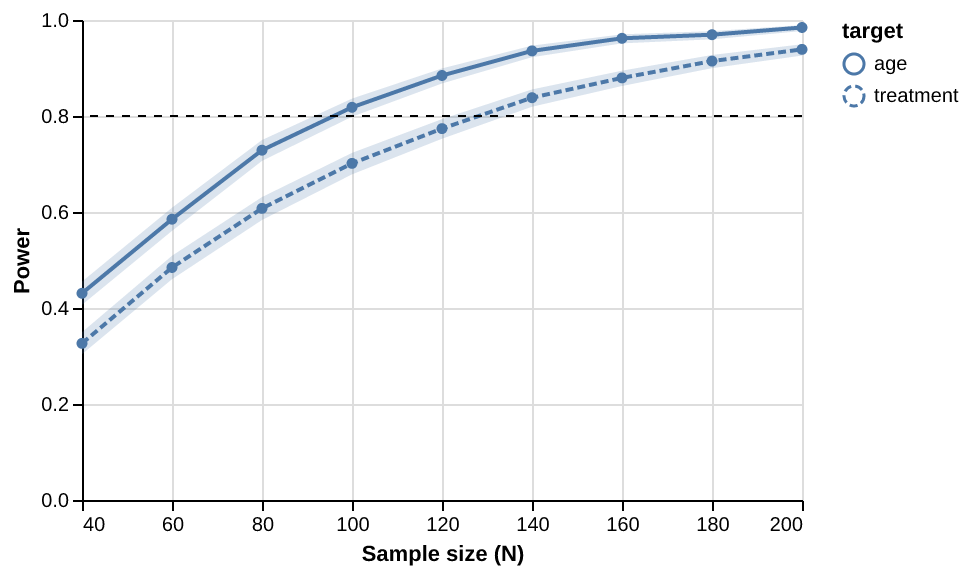
treatment needs N = 129, age 96 — note the answers land between grid
points: the headline is read off the fitted power curve, not snapped to the
nearest simulated size, and the Required N & 95% CI table puts a
Monte-Carlo interval around each one. The joint detection rows are the
figure to budget for: detecting both effects together needs N = 145, since a
study is only as powered as its weakest planned test. The curve shows power
climbing with sample size for each test. See
how required N is estimated for the method
and what the ≤ / ≥ / appr. markers mean when a search range misses the
answer.
The compact table (the landing-page form) prints automatically when you omit
verbose=False. Use .summary() when you want the confidence intervals and the
joint distribution.
next → Interactions